How will AI impact School Finance?
July 14, 2026
By Jim Schiele

Recent commentary around artificial intelligence (AI) has begun to shift. After months of predictions that AI would significantly reduce employment, industry leaders such as Sam Altman of OpenAI and Dario Amodei of Anthropic have acknowledged a more nuanced reality. Altman recently admitted earlier projections were overstated, while Amodei has suggested AI may ultimately support job growth. Current data reflects minimal overall labor market disruption, despite isolated layoffs.
As Molly Kinder describes in “The messy middle,” AI’s most significant impact will likely be on how work is performed rather than whether it exists. Moreover, widespread, deeply integrated adoption of AI technologies is expected to unfold gradually over decades unless organizations actively prioritize and accelerate implementation.
MoakCasey’s Vice President of School Finance
June edition of the Texas School Policy Network Newsletter
writes about the impact of the state’s growing AI infrastructure.
Transformation in School Finance
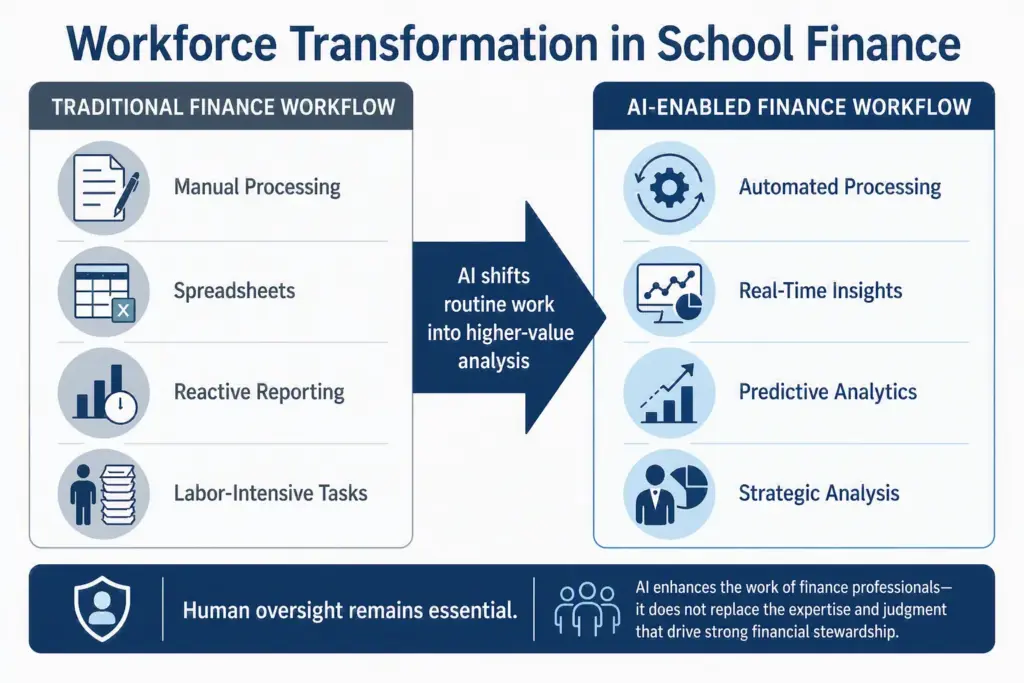
School finance departments have traditionally been labor-intensive, even as many processes have become automated. AI is now shifting these environments from manual data processing toward strategic analysis. Tasks such as invoice processing, payroll, and compliance reporting—historically time-consuming and prone to error—can now be automated or assisted by AI tools. These systems can categorize expenditures, match invoices to purchase orders, and flag discrepancies, improving both efficiency and accuracy. However, human oversight remains essential to ensure proper interpretation of data and appropriate decision-making. While staffing needs may evolve, AI is more likely to enhance job performance than eliminate positions entirely.
Enhancing Procurement and Efficiency, Fraud Protection, and Decision-Making
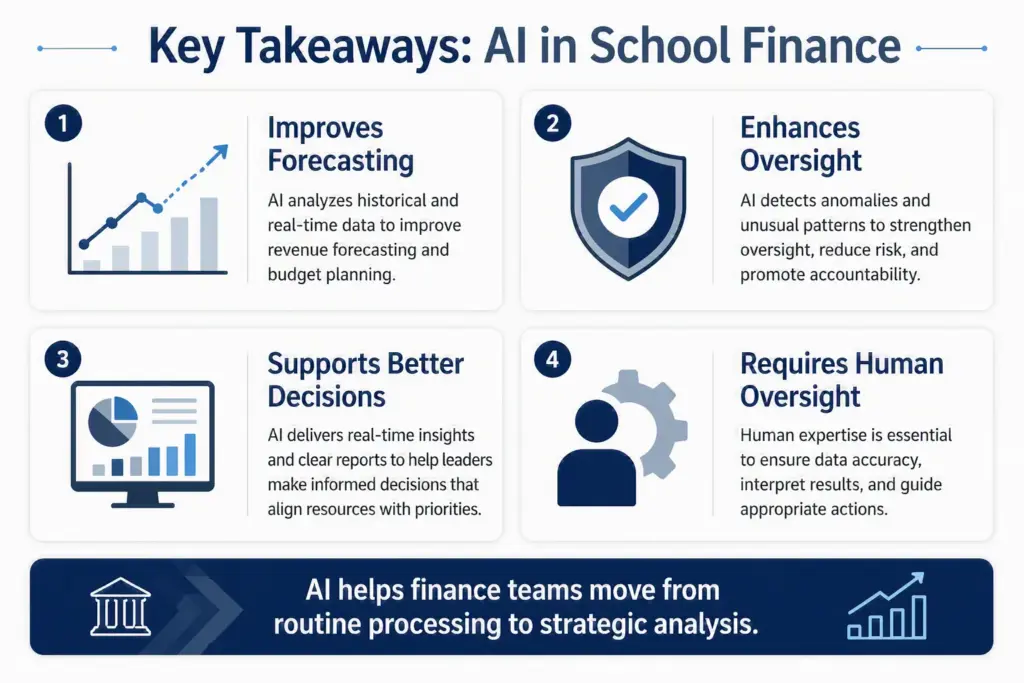
One of AI’s most valuable contributions is centered around predictive analytics. School districts rely on variables such as enrollment, property tax collections, and state funding formulas. Traditionally, these have been analyzed through complex spreadsheets, which are both labor-intensive and susceptible to error. AI can synthesize large volumes of historical and real-time data from multiple sources—such as PEIMS reports and appraisal district data—to improve revenue forecasting and budget planning. This enables districts to anticipate challenges earlier and make proactive adjustments instead of reacting after issues arise.
AI also strengthens financial oversight and fraud detection. Machine learning models can identify anomalies or unusual spending patterns that may indicate errors or misuse of funds. In a climate where transparency and accountability are increasingly important, these tools provide an added layer of assurance to administrators, school boards, and the public. However, effectiveness depends on the consistency of underlying data and the presence of knowledgeable personnel to interpret outputs and ensure appropriate follow-up.
Procurement is another area benefiting from AI. By analyzing purchasing trends both within a district and across multiple districts, AI can identify opportunities for cost savings. Systems may recommend bulk purchasing over individual orders or highlight vendors offering more competitive pricing. This capability is particularly valuable in Texas, where cooperative purchasing programs are common and can yield significant efficiencies.
Across all functions, AI supports improved decision-making. Real-time data insights and accessible reporting tools allow district leaders to quickly evaluate financial performance, operational efficiency, and resource allocation. This enables more informed decisions that align spending with district priorities and student needs. Additionally, AI can enhance communication and transparency by generating user-friendly financial reports that make complex data easier for stakeholders to understand.
Challenges to Consider
Despite these advantages, there are challenges to consider. Cybersecurity remains a critical concern, particularly as financial systems house increasingly sensitive data. Robust protections are necessary to meet state and federal requirements. Data quality and consistency also play a significant role in the effectiveness of AI. In environments with significant variability—such as fast-growing districts—initial outputs may be less reliable and require careful validation. Furthermore, implementing AI involves upfront investments in technology and staff training, which may present short-term barriers. However, these costs should be evaluated against long-term gains in efficiency, improved data quality, and potential staffing reallocation. In some cases, savings realized within finance departments may help fund enhancements to district technology infrastructure.
AI is poised to become an essential tool for districts striving to maximize limited resources. Its ability to automate routine processes, improve forecasting accuracy, and enhance operational efficiency can translate into measurable financial and administrative benefits.
At the same time, districts must carefully evaluate the growing number of AI solutions entering the market. Each system should be assessed not only for its potential benefits but also for its impact on existing technology infrastructure and overall district operations. Strategic, thoughtful adoption will be key.
Looking Ahead
While challenges remain, districts that effectively integrate AI into their finance and operational processes will be better positioned to strengthen fiscal management and improve overall performance—ultimately supporting stronger educational outcomes for students.
As always, we are available to further discuss how AI may impact your district.
Jim Schiele is Linebarger’s School Financial Consultant. He offers free assistance to Linebarger school district clients as they navigate budgets and meet financial deadlines. He can be reached at jim.schiele@lgbs.com.
This content is intended and provided solely for educational and/or informational purposes. It is not intended to provide legal advice, nor does your receipt of this content create an attorney-client relationship. This content is not a substitute for the specific legal advice of an attorney licensed in your jurisdiction.
If you are a current or prospective client this content may be subject to the attorney-client privilege or the attorney work product privilege or otherwise be confidential. Any dissemination, copying or use of this content by or to anyone other than the designated and intended recipient(s) is unauthorized.