Who Decides? Clear Roles Lead to More Effective Decisions
September 8, 2026
By Jim Schiele

Who decides whether a new program moves forward, how resources are allocated, or how a districtwide priority is implemented on a campus? In many school districts, the answer is not always clear.
That uncertainty can lead to duplicated work, delayed action, conflicting direction, and frustration at every level. By contrast, districts with clearly defined decision-making authority are better positioned to operate efficiently, build trust, and keep their attention focused on student outcomes.
The question is not whether decisions will be made. It is whether the right decisions will be made by the right people at the right level.
Understanding the Decision-Making Structure
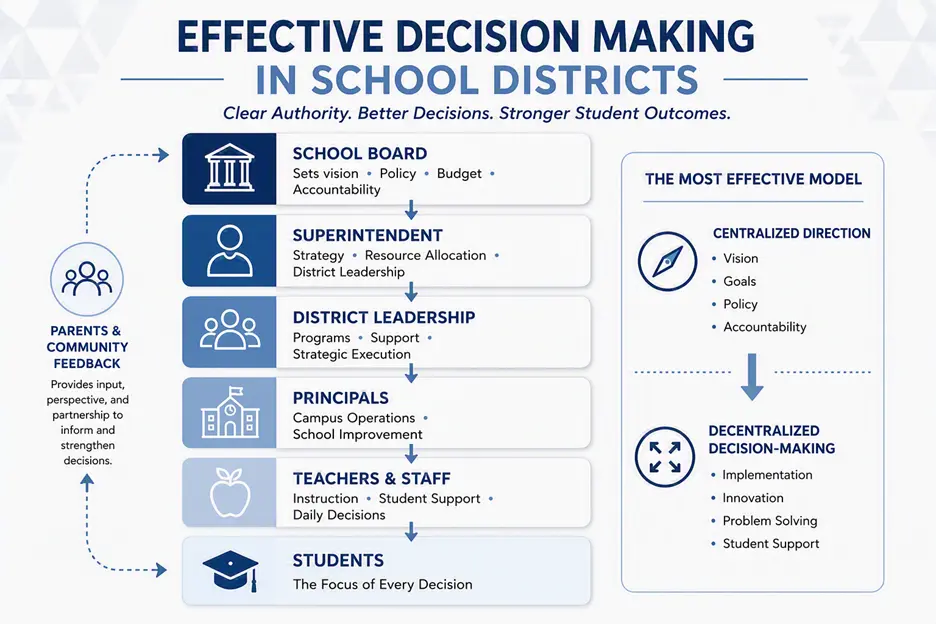
School districts operate most effectively when authority is distributed according to responsibility.
The School Board: Sets Direction
The board establishes the district’s vision, adopts policy, approves the budget, monitors performance, and selects and evaluates the superintendent. Its focus is the district’s “what” and “why,” rather than the day-to-day “how.”
The Superintendent: Turns Direction into Action
As the district’s chief executive, the superintendent translates board priorities into strategy, recommends policy, allocates resources, oversees operations, and maintains accountability.
District Leadership: Coordinates Execution
Cabinet members, assistant superintendents, and department leaders develop plans, manage districtwide programs, and coordinate the resources needed to achieve district goals.
Campus Principals: Lead Local Implementation
Principals make operational and instructional decisions at the campus level. They lead staff, support teaching and learning, shape school culture, and adapt district expectations to campus needs.
Teachers and Staff: Apply Frontline Expertise
Because they work closest to students, teachers and staff provide essential insight into instruction, implementation, and continuous improvement.
Families and Community Stakeholders: Inform and Strengthen Decisions
Stakeholder feedback helps leaders understand community priorities, anticipate concerns, and build support for district initiatives.
A Better Model: Districtwide Direction, Local Decision-Making
When too many decisions travel up the organizational chart, bottlenecks form. Progress slows, ownership declines, and district leaders spend valuable time resolving matters that could be handled closer to the work.
A more effective approach combines centralized direction with decentralized decision-making.
The board and superintendent establish districtwide priorities, expectations, guardrails, and accountability measures. Within that framework, decisions are made as close as practical to the point of implementation.
What This Looks Like in Practice
Consider a districtwide goal to improve third-grade reading:
- The board establishes the goal.
- The superintendent allocates resources and defines district expectations.
- Curriculum leaders provide research-informed instructional guidance.
- Principals determine how the strategy will be implemented on their campuses.
- Teachers make daily instructional decisions based on student needs.
Each level contributes to the same goal without duplicating or overstepping another level’s role. The result is alignment without micromanagement.
Why Clarity Improves Performance
Clear decision authority creates several advantages:
- Faster action. Routine decisions do not have to pass through unnecessary layers of approval.
- Better-informed decisions. Authority rests with the people who have the most relevant knowledge and experience.
- Stronger accountability. Everyone understands who owns the decision and who is responsible for the outcome.
- Greater trust and engagement. Employees with meaningful authority are more likely to take initiative and remain invested in district goals.
- More strategic leadership. Senior leaders can focus on long-term priorities instead of routine operational matters.
A Simple Test for Every Decision
Before a major decision moves forward, district leaders can ask:
- Who has the formal authority to make this decision?
- Who has the knowledge needed to inform it?
- Who will be responsible for implementing it?
- Who is accountable for the result?
- Who needs to be consulted or informed?
If those answers are unclear, the decision-making process probably is too.
Effective school districts do not eliminate hierarchy. They make it purposeful.
The board sets direction. District leaders create the conditions for success. Campus leaders adapt and implement. Teachers and staff respond to the students in front of them. Families and community members help keep the district connected to those it serves.
As always, we are available to further discuss these topics and more.
Jim Schiele is Linebarger’s School Financial Consultant. He offers free assistance to Linebarger school district clients as they navigate budgets and meet financial deadlines. He can be reached at jim.schiele@lgbs.com.
This content is intended and provided solely for educational and/or informational purposes. It is not intended to provide legal advice, nor does your receipt of this content create an attorney-client relationship. This content is not a substitute for the specific legal advice of an attorney licensed in your jurisdiction.
If you are a current or prospective client this content may be subject to the attorney-client privilege or the attorney work product privilege or otherwise be confidential. Any dissemination, copying or use of this content by or to anyone other than the designated and intended recipient(s) is unauthorized.