From Bond Approval to Financial Accountability
November 9, 2026
By Jim Schiele

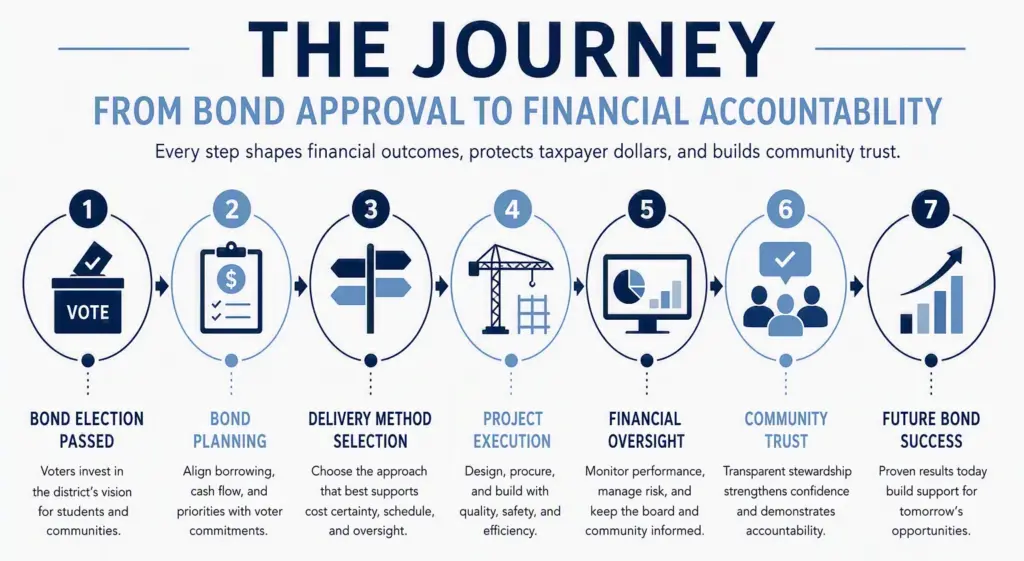
Winning voter approval for a bond election is the starting point, not the finish line. Once debt is authorized, district leaders must turn community trust into completed facilities while protecting the district’s long-term financial stability.
According to the National Center for School Infrastructure, Texas schools hold $129 billion in long term debt as of the end of 2024, up from $9 billion in 1995. Much of this debt is used to build, improve, and maintain school facilities.
The decisions made regarding how projects are procured, delivered, and managed can determine whether a bond program stays on schedule, remains aligned with available funds, and fulfills the commitments made to taxpayers.
Understanding how construction management methods integrate with bond planning and financial oversight is essential for districts determined to deliver both projects and fiscal discipline.
Start With the Financial Plan
A bond program is a financing plan before it becomes a building program. The plan must coordinate the timing of bond sales with project cash needs, establish realistic expectations for cost and schedule, and define how progress will be reported to the board and community. The selected delivery method affects each of these decisions.
That is why procurement should not be treated as a stand-alone operational choice. It is a financial governance decision. A method that works well for one project may be a poor fit for another because project complexity, design maturity, schedule pressure, market conditions, and the district’s internal capacity are different.
Know the Proposal Options
Texas Government Code Chapter 2269 establishes contracting and delivery procedures for public construction projects, including competitive bidding, competitive sealed proposals, construction manager-agent, construction manager-at-risk, design-build, and job order contracting. Districts should work with legal and procurement counsel to apply the current statutory requirements to each project.
While the table below outlines options for proposals, there is no “best method.” The appropriate choice depends on the project and the district’s documented selection criteria, legal requirements, resources, and risk tolerance.
| Method | Often fits | Financial and oversight lens |
| Competitive bidding | Projects with a complete, well-defined design | Emphasizes price competition and transparency. Cost visibility comes later because bidding follows completion of the design. |
| Competitive sealed proposals | Projects where qualifications, approach, schedule, or other published criteria matter with price | Supports a best-value evaluation rather than a price-only decision and may allow negotiation with the highest-ranked proposer under applicable law. |
| Construction manager-agent (CMA) | Programs seeking an adviser to coordinate planning and construction while the district holds trade contracts | Preserves strong owner control but requires the district to manage direct contractual and construction risk carefully. |
| Construction manager-at-risk (CMAR) | Complex or phased projects that benefit from early contractor input | Adds preconstruction input and may establish a guaranteed maximum price. The timing, assumptions, allowances, and contingencies behind that price still require close review. |
| Design-build | Projects where integrated design and construction may support an accelerated schedule | Creates one design-and-construction contract, which can streamline coordination. The district must still define scope, performance expectations, and independent representation clearly. |
| Job order contracting | Recurring repairs, renovations, and smaller construction tasks | Can shorten procurement for qualifying work through an indefinite-delivery structure and preset pricing methodology. It is generally not the primary approach for a large new campus. |
Program Management – An Added Oversight Function
For a large or multiyear bond, leaders must oversee more than individual projects. They need a portfolio-level view that connects schedules, budgets, commitments, expenditures, and future cash needs across the entire program.
A program manager or owner’s representative does not replace the architect, contractor, finance team, or district leadership. Instead, the role can create a consistent control framework across projects by coordinating cash-flow forecasts, standardizing cost reporting, validating information, identifying emerging pressure, and linking physical progress to expenditures.
Match the Method to the Need
Strong districts do not begin by asking which delivery method is best. They begin with the project’s needs and the promises made to the community. The following questions help connect procurement to the financial plan:
- How complete is the design, and when does the district need reliable cost information?
- Does the project require early contractor input, phasing, or an accelerated schedule?
- How will the delivery method affect the timing of expenditures and future bond sales?
- Which risks remain with the district, and which are contractually assigned to another party?
- Does the district have sufficient internal capacity to manage the contracts and reporting model?
- What information will the board and public receive, how often, and in what format?
| Bond Planning Need | Delivery Method Strength |
| Early cost certainty | CMAR / Competitive Bidding / Competitive Sealed Proposal |
| Maximum bid transparency | Competitive Bidding / Competitive Sealed Proposal / Job Order Contracting |
| Speed and escalation control | Design–Build |
| Bond sale alignment | CMAR / Competitive Sealed Proposal |
Make Oversight Continuous
Annual audits, change-order approvals, and monthly board reports are important, but they are not the full oversight system. Effective governance gives leaders a current view of where the program stands, what the next financing or construction milestone requires, and which risks have not yet reached the budget.
The objective is not simply to report what has already happened. It is to see pressure early enough to preserve choices. Delivery methods, contract terms, program controls, and reporting practices should work together to make risk visible before the district has limited options. What we see coming in the future that is not according to our schedule must be highlighted, along with the options we have to deal with it. This includes both positive and negative developments.
Delivering on the Promise
Every construction project eventually reaches a conclusion. The better measure of success is whether the district delivered what voters authorized while maintaining financial accountability along the way.
Construction delivery methods are more than procurement preferences. They shape transparency, risk allocation, cash flow, schedule, and public trust. When bond planning, project delivery, and financial oversight work together, districts do more than build facilities. They strengthen confidence in every future investment the community is asked to make.
Dashboards can help keep the public up to date on progress of projects and expected delivery dates.
Maintaining Voter Trust
Voters authorize debt because they believe the district has:
- A realistic plan
- Disciplined controls
- A commitment to stewardship
Construction delivery methods are not operational preferences; they are financial strategies that determine whether a bond program stays aligned with its original commitments.
Districts that intentionally connect delivery methods to bond planning and oversight don’t just complete projects; they complete promises—and protect the district’s financial reputation long after the ribbon cuttings. As always, we welcome your thoughts, comments or questions.
Jim Schiele is Linebarger’s School Financial Consultant. He offers free assistance to Linebarger school district clients as they navigate budgets and meet financial deadlines. He can be reached at jim.schiele@lgbs.com.
This content is intended and provided solely for educational and/or informational purposes. It is not intended to provide legal advice, nor does your receipt of this content create an attorney-client relationship. This content is not a substitute for the specific legal advice of an attorney licensed in your jurisdiction.
If you are a current or prospective client this content may be subject to the attorney-client privilege or the attorney work product privilege or otherwise be confidential. Any dissemination, copying or use of this content by or to anyone other than the designated and intended recipient(s) is unauthorized.